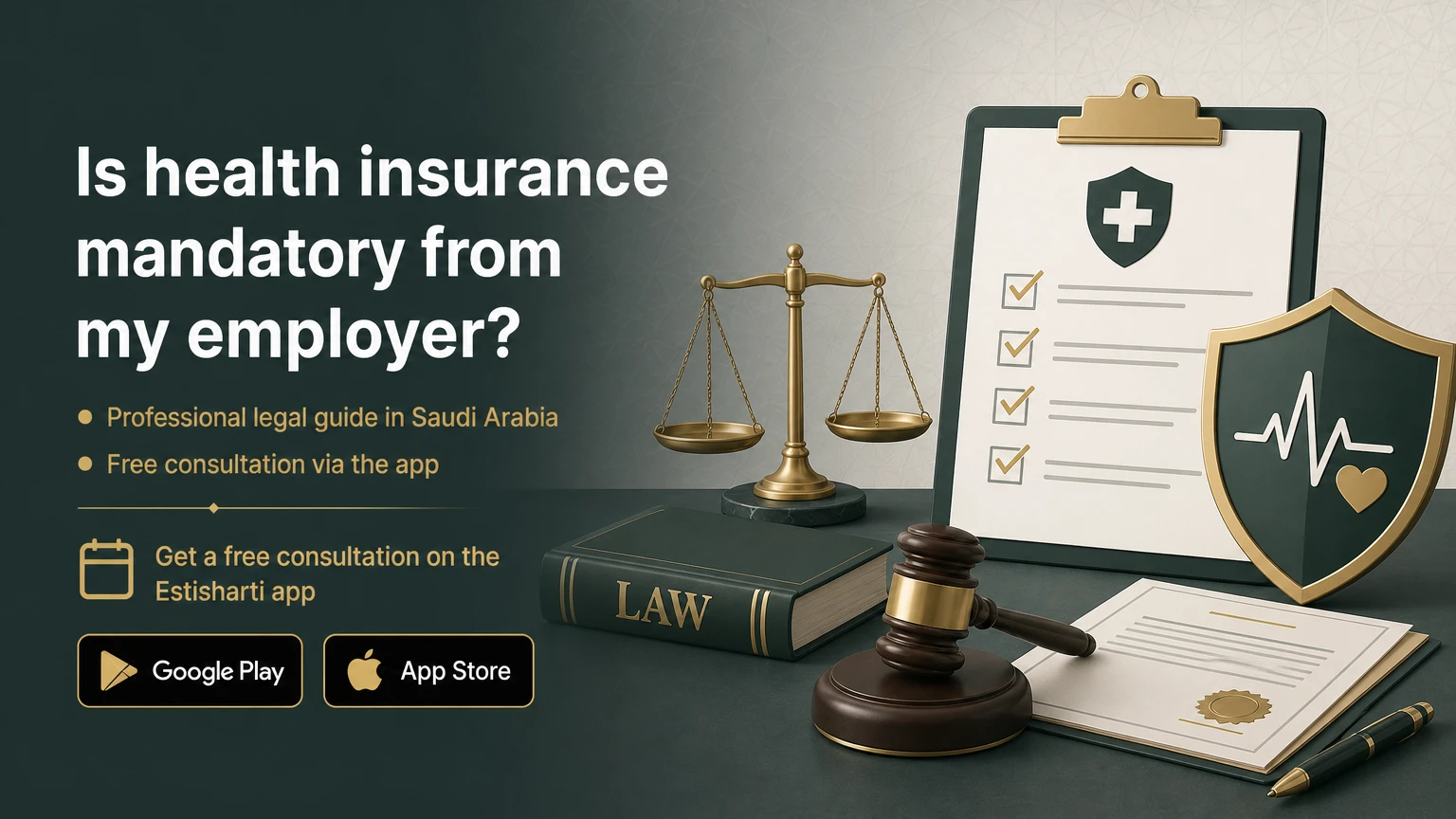
In Saudi Arabia, employers are legally required to provide health insurance to their employees, ensuring access to medical care as part of labor law compliance. This mandatory provision applies to both Saudi and non-Saudi workers in the private sector. Saudi law obligates employers to register their employees in approved health insurance schemes, a protection enforced by key labor regulations. To better navigate employer obligations, visit the Estisharti app for personalized guidance from licensed Saudi lawyers.
- Health insurance is legally mandatory for all private sector employees in Saudi Arabia.
- Employers must enroll both Saudi and non-Saudi workers in health insurance plans.
- Failure to provide insurance may result in legal penalties and business restrictions.
- This requirement is governed by the Cooperative Health Insurance Law and enforced by Saudi regulators.
Is Employer-Provided Health Insurance Required by Saudi Law?
Yes, under the Cooperative Health Insurance Law (Royal Decree No. M/10), all private sector employers in Saudi Arabia are obligated to provide health insurance to their employees. Article 3 specifically requires employers to subscribe to licensed insurance providers on behalf of each worker. This ensures employees and their dependents have access to necessary medical care. In Estisharti consultations, questions often arise regarding coverage details for various categories of employees. For further legal explanations, you can consult the full text of this regulation via the Bureau of Experts at the Council of Ministers. Employers who fail to meet these obligations face possible penalties and may be prevented from renewing employee work permits, as stipulated by Article 14. If you're unsure whether your employer has registered you under a qualifying scheme, you can check your status using the My.Gov.sa National Portal, where employment and insurance information is integrated with government databases.
Takeaway: Saudi law clearly obligates private sector employers to provide health insurance for all their employees.
What Are the Consequences if My Employer Doesn’t Provide Health Insurance?
If an employer fails to provide mandatory health insurance, the Ministry of Human Resources and Social Development—as well as the Council of Cooperative Health Insurance—may impose sanctions. These can include financial fines, suspension of essential ministry services, and ineligibility to issue or renew work permits for employees. Article 14 of the Cooperative Health Insurance Law serves as the legal basis for such penalties. In our experience at Estisharti, employees are often unaware that they can file an official complaint through the Najiz Platform or consult directly with a licensed Saudi lawyer for recourse. Documenting all employment details and communications with employers is critical if you need to pursue a claim.
Takeaway: Failure by employers to insure workers can result in strict legal penalties, business suspensions, and fines.
Who Is Covered by the Mandatory Employer Health Insurance?
Mandatory health insurance covers all private sector employees, both Saudi nationals and expatriates, as outlined in the Cooperative Health Insurance Law. Coverage also typically extends to eligible dependents. However, government (public sector) employees are covered by separate state-provided healthcare schemes. A common misconception, as we often clarify in free legal consultations via the Estisharti legal consultation platform, is thinking part-time, probationary, or domestic workers are excluded. The law explicitly includes contract workers once employment status is formalized. For specific exceptions and coverage types, you can refer to more details on the Bureau of Experts website.
Takeaway: All private sector workers—Saudis and non-Saudis—must receive health insurance from their employers.
How Can I Confirm or Enforce My Right to Health Insurance?
Employees can verify their health insurance status through the integrated services on the My.Gov.sa National Portal using their national ID or iqama. If insurance is missing or inactive, employees may approach the Ministry of Human Resources and Social Development for redress. Filing an official complaint on the Najiz Platform can prompt an investigation. For step-by-step support, you may request a free legal consultation to clarify procedures, gather required documentation, and maximize your chances of a quick resolution. Prompt action and proper record-keeping are key, especially in cases of denied medical claims or employment disputes over insurance coverage.
Takeaway: Employees have accessible channels to confirm and enforce their health insurance rights using official Saudi digital platforms.
Health insurance is a legally required benefit in Saudi Arabia’s private sector, where the employer pays for a basic policy covering necessary healthcare services for all employees under the Cooperative Health Insurance Law.
- Ask your HR department to confirm your health insurance registration.
- Log in to the My.Gov.sa National Portal to verify insurance status.
- Collect contract and payroll records proving employment.
- If not insured, notify your employer in writing, requesting immediate coverage.
- If unresolved, file a complaint via the Najiz Platform.
- Seek legal advice through the Estisharti app if needed.
This article provides general legal information and does not replace consulting a licensed Saudi lawyer for your specific case. For tailored advice, use the Estisharti app.
Frequently Asked Questions
Is it legal for an employer in Saudi Arabia to refuse health insurance coverage?
No, under Article 3 of the Cooperative Health Insurance Law, all private sector employers must provide health insurance to their employees. If your employer refuses, you can file a claim through the Najiz Platform or seek a lawyer’s help for enforcement.
Does employer health insurance also cover my family in Saudi Arabia?
Employers are required to insure employees and, in many cases, eligible dependents (spouse and children) as stipulated in policy terms. Specific coverage depends on the policy, so check details through your HR department or via My.Gov.sa.
Can I report an employer for not giving health insurance?
Yes. Employees may report non-compliance to the Ministry of Human Resources and Social Development, or submit a complaint online via the Najiz Platform. Legal assistance from the Estisharti app can help with documentation.
Is health insurance mandatory for government employees in Saudi Arabia?
No, government (public sector) employees are typically covered under state-provided healthcare systems, not through employer-sponsored insurance, as clarified by the Bureau of Experts.