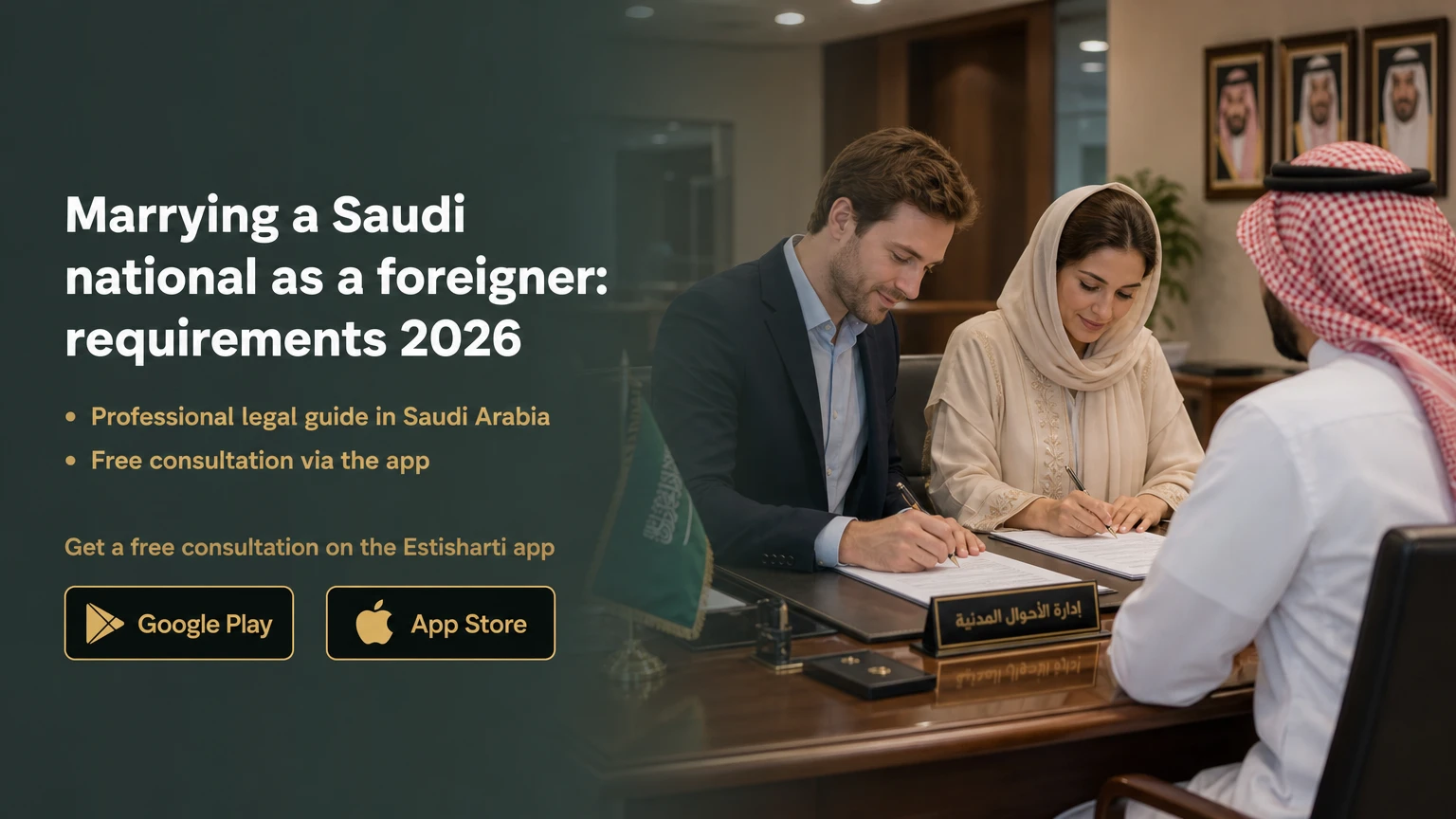
Marrying a Saudi national as a foreigner in 2026 requires fulfilling legal permissions, cultural considerations, and government approvals including obtaining a marriage license, ensuring no legal impediments, and completing documentation. Foreigners marrying Saudis must navigate a structured legal process outlined by the Saudi Personal Status Law and various ministries, with requirements differing based on nationality, religion, and residency status. The marriage contract is not merely a private affair but a regulated legal event, making awareness of all procedural and documentary expectations essential. To ensure compliance and avoid delays, many turn to the Estisharti app for personalized guidance and free consultations from licensed Saudi lawyers who have assisted thousands of mixed-nationality marriages.
- Marriage between foreigners and Saudi nationals is governed by the Saudi Personal Status Law and subject to ministerial approval.
- Applicants must provide identity documents, proof of single status, and pass background checks via the Najiz Platform.
- Special requirements apply for non-Muslim foreigners and for Saudi women marrying foreign men.
- Marriage contracts must be registered with the Ministry of Justice to be legally recognized in Saudi Arabia.
- Processing times and documentation needed may differ depending on region, nationality, and whether the foreigner resides in the Kingdom.
- Using the Estisharti legal consultation platform can prevent costly errors and speed up approval.
What are the primary requirements for marrying a Saudi national as a foreigner in 2026?
The fundamental requirements for a foreigner seeking to marry a Saudi national in 2026 include compliance with the Saudi Personal Status Law and obtaining the necessary approvals. Both parties must be of marriageable age, per Article 9 of the Personal Status Law, with women generally needing the permission of a guardian (wali), and additional ministerial approval for mixed-nationality marriages as stipulated in Ministerial Resolution No. 824/1395. Official documents required include valid passports, residency permits (iqama if inside the Kingdom), proof of single status, medical examinations, and for Saudi women, written consent from their guardian and a letter of non-objection from the Ministry of Interior. The marriage must be conducted before an authorized official and registered via the Najiz Platform, the digital system for legal documentation operated by the Ministry of Justice. Applications are typically reviewed to ensure no legal impediments (such as prior unfinalized marriages) exist, and both parties will undergo background checks. Legal and procedural nuances, such as restrictions for non-Muslim foreigners and country-specific requirements, are routinely addressed during a free legal consultation on Estisharti.
Takeaway: Both parties must meet age, documentation, and approval requirements, with all marriages registered via the Najiz Platform for legal validity.
Special conditions: Marriage approval for Saudi women and non-Muslims
The approval process differs significantly when a Saudi woman seeks to marry a non-Saudi man, especially if the prospective husband is non-Muslim or not resident in Saudi Arabia. Saudi law, per Article 5 of the Saudi Nationality Law and Ministry of Interior policies, does not permit Saudi women to marry non-Muslim men. Additionally, even for Muslim foreigners, the process involves more scrutiny, including extensive background checks, proof of financial stability, and family consent. The Ministry of Justice requires Saudi women to obtain explicit written approval from the Ministry of Interior (as per Royal Decree M/6/2022) prior to marriage. We frequently help clients through Estisharti avoid delays by ensuring all consular and Ministry documents are correctly prepared. Non-residents or those living abroad must have all foreign-issued documents legalized by the Saudi embassy and translated into Arabic. If the applicant is divorced or widowed, additional documentation (e.g., death certificate, divorce decree) is mandatory.
Takeaway: Saudi women need explicit government approval to marry foreigners, and marriage to non-Muslims is not legally permitted.
Step-by-step: The legal process for marrying a Saudi national as a foreigner
The legal marriage process for non-Saudis in 2026 starts with collecting required documents and submitting a marriage license application on the Najiz Platform. This includes ID documents, proof of single status, and medical reports as mandated by Article 15 of the Saudi Personal Status Law. Next, parties must pass required background checks, and the application is reviewed by the Ministry of Justice and, in many cases, the Ministry of Interior. Once approvals are obtained, the marriage is solemnized before an official marriage officer (Ma'zoun). If either party is non-Muslim, the marriage can only proceed if the foreign spouse is a Muslim, per Saudi law. The final step is the official registration of the contract, after which both parties receive an attested marriage certificate. From our extensive Estisharti consultations, delays usually stem from incomplete supporting documents or unapproved status due to non-Muslim religion. For tailored assistance, our clients often rely on a licensed Saudi lawyer via Estisharti to facilitate the process.
Takeaway: Submitting accurate documents and meeting all ministerial steps on Najiz is crucial for mixed-nationality marriages to be recognized in Saudi Arabia.
Common pitfalls and how to avoid marriage application rejection
We see at Estisharti that the most common reasons for marriage application rejections involve incomplete documents, unregistered previous marriages, or misunderstanding of religious prohibitions. Article 10 of the Personal Status Law stresses the requirement for unambiguous status documentation. Many applicants, particularly foreign men, may overlook the need for ministry-issued letters, while foreign women marrying Saudi men might miss the step of obtaining their local embassy's no-objection certificate. Another frequent error is the lack of certified translations or improperly legalized foreign documents—such issues can delay approvals by weeks. Our legal consultants recommend thorough preparation and early review of documentation, and the Estisharti app provides tailored checklists to prevent these oversights. Utilizing platforms like the My.Gov.sa National Portal helps applicants track the latest updates to marriage regulations and submission requirements.
Takeaway: Avoiding incomplete documentation and adhering closely to ministry instructions are key to successful and timely marriage approval.
Post-marriage rights, legal status, and the impact on residency
Once married and the contract is registered in Saudi Arabia, a foreign spouse may be eligible for residency rights, but automatic Saudi nationality is not granted. Article 16 of the Saudi Nationality Law outlines the eligibility and procedural requirements for citizenship, which typically require years of lawful residence and demonstration of good conduct. Instead, most foreign spouses qualify to apply for a "dependent iqama" or renewable residency, often supported by their Saudi partner's sponsorship. Additionally, the marriage contract's registration affords legal protections for spousal rights under the Personal Status Law, including rights to support, inheritance, and family court recourse. To understand how marriage can impact other legal capacities, such as property ownership (see: Can foreigners buy property in Saudi Arabia in 2026?), consult a licensed lawyer or leverage resources provided by the Saudi Bar Association for deeper clarity.
Takeaway: Marriage to a Saudi does not confer citizenship but allows foreign spouses to legally reside in Saudi Arabia and receive family law protections.
How Estisharti guides you through Saudi marriage legalities
The Estisharti legal consultation platform offers invaluable support for foreigners navigating Saudi marriage law in 2026. Our experience shows that in-depth consultation minimizes errors, ensures all ministry and embassy requirements are met, and accelerates approvals—especially for complex cases involving prior marriages or religious conversions. Estisharti’s lawyers review your unique situation, provide step-by-step guidance, prepare checklists tailored to your nationality and status, and monitor for regulatory changes. For example, in 2025, Estisharti successfully assisted numerous clients to hasten processing by directly liaising with the Ministry of Justice and delivering Arabic translations of all documents. For wider legal concerns such as labor rights (see: Saudi Labor Law 2026: full guide for foreign employees) or rental property rights, Estisharti’s expertise spans all crucial legal areas affecting expatriates in the Kingdom.
Takeaway: Estisharti provides specialized legal guidance and document support, streamlining every aspect of mixed-nationality marriage in Saudi Arabia.
Recent regulatory updates and practical examples (2025–2026)
Saudi marriage laws continue to evolve, with several regulatory updates in 2025 and 2026 focusing on digital application systems and stricter documentation checks. Notably, the Bureau of Experts at the Council of Ministers issued clarifications requiring all non-Saudi documents to be legalized and translated, a frequent cause of delay for expatriates. Additionally, new digital interfaces on the Najiz Platform have improved processing times, though strict compliance with updated document checklists is now enforced. For instance, one Estisharti client, a non-GCC Muslim professional, faced an unforeseen holdup until obtaining Ministry of Interior clearance due to a name mismatch in translated documents. Lessons from such 2026 case studies suggest that proactive lawyer assistance and use of official digital portals are critical. Applicants are encouraged to consult the Ministry of Justice and seek a free legal consultation to address any unique circumstances promptly.
Takeaway: Recent digital reforms emphasize document accuracy and timely use of official e-platforms for smoother mixed-nationality marriage approvals.
Marrying a Saudi national as a foreigner in 2026 means fulfilling specific legal, religious, and procedural requirements, including obtaining ministry approvals, verified documentation, and registering the union with the Ministry of Justice to ensure full recognition of spouse rights in Saudi Arabia.
- Confirm both parties meet age and religious eligibility per Saudi Personal Status Law.
- Gather and legalize required documents including ID, proof of single status, and medical certificates.
- Submit marriage application and all documents digitally via the Najiz Platform.
- Undergo ministry and background checks; obtain Ministry of Interior approval for Saudi women or special cases.
- Solemnize the marriage before a recognized official (Ma'zoun).
- Register the marriage contract officially with the Ministry of Justice.
- Apply for dependent iqama or residency based on marriage if residing in Saudi Arabia.
| Requirement | Foreign Man | Foreign Woman |
|---|---|---|
| Minimum Age | Varies by regulation, usually 18+ | Varies by regulation, usually 18+ |
| Religious Eligibility | Must be Muslim if marrying Saudi woman | Must be Muslim (Saudi law prohibits non-Muslim men) |
| Ministry Approval | Yes, via Najiz/Application | Yes, and Ministry of Interior approval also required |
| Guardian Consent Needed | No | Yes (for Saudi woman) |
| Embassy No-Objection Certificate | Yes, often required | Yes, often required |
| Application Method | Najiz Platform / In-Person | Najiz Platform / In-Person |
| Residency/Rights Post-Marriage | Eligible for dependent iqama, not citizenship | Eligible for dependent iqama, not citizenship |
This guide provides general information only and does not replace consulting a licensed Saudi lawyer for individual cases. Regulations frequently change—always seek an updated legal consultation before proceeding with any marriage application.
Conclusion
The Estisharti app offers free legal consultations from licensed lawyers across the Kingdom — start your consultation today.
Frequently Asked Questions
How long does it take to get marriage approval when a foreigner marries a Saudi national?
Processing times for marriage approval can range from two weeks to several months, depending on nationality, residency status, and document completeness. Checking progress via the Najiz Platform and securing professional legal help often speeds up the process.
Can non-Muslim foreigners marry Saudi nationals in 2026?
Saudi law does not permit non-Muslim men to marry Saudi women, and most cases require both parties to be Muslim. Current rules can be reviewed with the Ministry of Justice to clarify eligibility for exceptions or procedural updates.
Does marrying a Saudi national give a foreigner Saudi citizenship?
No, marriage to a Saudi national does not automatically grant citizenship. The foreign spouse may apply for residency and, after meeting strict conditions, may eventually be eligible for citizenship under Article 16 of the Saudi Nationality Law.
What documents are required for a foreigner to marry a Saudi citizen?
Documents typically include ID, passports, proof of single status, medical reports, embassy no-objection certificates, and legalized translations. Requirements change by nationality, so consult the Estisharti app or your embassy for updated checklists.
Where is the marriage registered and is it recognized abroad?
The marriage contract must be registered with the Ministry of Justice for legal recognition in Saudi Arabia. Some countries may require further legalization of documents for recognition abroad—contact your country's embassy for guidance.
What are the main reasons foreigner-Saudi marriage applications are rejected?
The most common causes for rejection include incomplete documents, previous unfinalized marriages, and not meeting religious requirements. Consulting a licensed Saudi lawyer via Estisharti helps applicants avoid these pitfalls and prepare correctly.
How can Estisharti help with the marriage process for foreigners?
The Estisharti app connects users to licensed Saudi lawyers who guide you through the documentation, approval, and digital registration requirements, helping ensure a compliant, faster, and stress-free process.